Pages

Wednesday, November 7, 2012

UFO enthusiasts admit the truth may not be out there after all


Declining numbers of “flying saucer” sightings and failure to establish proof of alien existence has led UFO enthusiasts to admit they might not exist after all.

Dozens of groups interested in unidentified flying objects
have closed due to lack of interest
 Photo: ALAMY
For decades, they have been scanning the skies for signs of alien activity.
But having failed to establish any evidence for the existence of extraterrestrial life, Britain’s UFO watchers are reaching the conclusion that the truth might not be out there after all.
Enthusiasts admit that a continued failure to provide proof and a decline in the number of “flying saucer” sightings suggests that aliens do not exist after all and could mean the end of “Ufology” – the study of UFOs – within the next decade.
Dozens of groups interested in the flying saucers and other unidentified craft have already closed because of lack of interest and next week one of the country’s foremost organisations involved in UFO research is holding a conference to discuss whether the subject has any future.
Dave Wood, chairman of the Association for the Scientific Study of Anomalous Phenomena (Assap), said the meeting had been called to address the crisis in the subject and see if UFOs were a thing of the past.
“It is certainly a possibility that in ten years time, it will be a dead subject,” he added.
“We look at these things on the balance of probabilities and this area of study has been ongoing for many decades.
“The lack of compelling evidence beyond the pure anecdotal suggests that on the balance of probabilities that nothing is out there.
“I think that any UFO researcher would tell you that 98 per cent of sightings that happen are very easily explainable. One of the conclusions to draw from that is that perhaps there isn’t anything there. The days of compelling eyewitness sightings seem to be over.”
He said that far from leading to an increase in UFO sightings and research, the advent of the internet had coincided with a decline.
Assap’s UFO cases have dropped by 96 per cent since 1988, while the number of other groups involved in UFO research has fallen from well over 100 in the 1990s to around 30 now.
Among those to have closed are the British Flying Saucer Bureau, the Northern UFO Network, and the Northern Anomalies Research Organisation.
As well as a fall in sightings and lack of proof, Mr Wood said the lack of new developments meant that the main focus for the dwindling numbers of enthusiasts was supposed UFO encounters that took place several decades ago and conspiracy theories that surround them.
In particular, he cited the Roswell incident, in 1947 when an alien spaceship is said to have crashed in New Mexico, and the Rendlesham incident in 1980, often described as the British equivalent, when airmen from a US airbase in Suffolk reported a spaceship landing.
Mr Wood added: “When you go to UFO conferences it is mainly people going over these old cases, rather than bringing new ones to the fore.
“There is a trend where a large proportion of UFO studies are tending towards conspiracy theories, which I don’t think is particularly helpful.”
The issue is to be debated at a summit at the University of Worcester on November 17 and the conclusions reported in the next edition of the association’s journal, Anomaly.
The organisation, which describes itself as an education and research charity, was established in 1981. Its first president was Michael Bentine, the comedian and member of the Goons.
It contains both sceptics and believers in UFOs and has been involved in several notable sightings and theories over the years.
Its current president Lionel Fanthorpe has claimed in its journal that King Arthur was an alien who came to Earth to save humans from invading extraterrestrials.
The summit follows the emergence earlier this year of the news that the Ministry of Defence was no longer investigating UFO sightings after ruling there is “no evidence” they pose a threat to the UK.
David Clark, a Sheffield Hallam University academic and the UFO adviser to the National Archives, said: “The subject is dead in that no one is seeing anything
evidential.
“Look at all the people who now have personal cameras. If there was something flying around that was a structured object from somewhere else, you would have thought that someone would have come up with some convincing footage by now – but they haven’t.
“The reason why nothing is going on is because of the internet. If something happens now, the internet is there to help people get to the bottom of it and find an explanation.
“Before then, you had to send letters to people, who wouldn’t respond and you got this element of mystery and secrecy that means things were not explained.
“The classic cases like Roswell and Rendlesham are only classic cases because they were not investigated properly at the time.”
But Nick Pope, who ran the MoD’s UFO desk from 1991 to 1994 and now researches UFO sightings privately, said there was a future for the subject: “There’s a quantity versus quality issue here.
“So many UFO sightings these days are attributable to Chinese lanterns that more interesting sightings are sometimes overlooked.
“The same is true with photos and videos. There are so many fakes on YouTube and elsewhere, it would be easy to dismiss the whole subject out of hand.
“The danger is that we throw out the baby with the bathwater. And as I used to say at the MoD, the believers only have to be right once.”

Bram Stoker books the subject of latest Google doodle


Bram Stoker's 165th birthday is being marked by a Google doodle.

Bram Stoker, born Abraham Stoker, was an Irish novelist and short story writer, best known today for his 1897 novel Dracula.

Stoker wrote his first novel, The Primrose Path, in 1875. It appeared in five issues of The Shamrock (Dublin) with the first instalment appearing on February 6, 1875 and the last on March 6, 1875. The novel was accompanied by five unsigned illustrations that depicted scenes from the story.

His second novel was The Snake's Pass, published in 1890. It centred on the troubled romance between an English tourist and a local Irish peasant. The Snake's Pass was set in his native Ireland - his only novel to do so. Bram Stoker wrote two more books (The Watter's Mou' and The Shoulder of Shasta) before writing the book he's best remembered for even today.

Before writing Dracula, Stoker spent considerable time researching European folklore and mythological stories of vampires. Dracula was an epistolary novel, written as a collection of realistic, but completely fictional, diary entries, telegrams, letters, ship's logs, and newspaper clippings, all of which added a level of detailed realism to the story, a skill Stoker developed as a newspaper writer.

The response to Dracula at the time was rather average - it wasn't until after Stoker's death that the novel became very popular.

Bram Stoker wrote seven other novels after Dracula, but none that became as popular.

Stoker died on 20 April 1912 at age 64 in London, England

Cheapest Asus tablet with Jelly Bean coming in Jan


Asus had yesterday launched Vivo Tab RT & a notebook-tablet hybrid 'Taichi', running on Windows RT OS in India.

Asus will make its entry into the affordable tablet segment by launching a 7 inch tablet in India in next two months.
Alex Huang, managing director, system business group, Asus India said to The Mobile Indian, "Asus will launch a sub Rs 15,000 Android Jelly Bean based 7 inch tablet for India in January."
He further added, "Till now we didn't have a tablet catering to the entry level buyers in the country, which is quite a huge market, but with the launch of 7 inch tab in January, Asus will address this issue."
Asus had yesterday launched Vivo Tab RT and a notebook-tablet hybrid, called Taichi, running on Windows RT operating system in India.
Vivo Tab RT has been priced at Rs 61,999 while Taichi has a price tag of Rs 1,39,999. Both the devices will be available in the market from December onwards.
The Asus Vivo Tab RT features a 10.1 inch Super IPS+ panel with 178 degree viewing angle. Asus has packed a quad core Nvidia Tegra 3 mobile processor for ultra fast performance. This tablet also comes with an optional keyboard dock with a built-in battery to provide extended battery life to the tablet but its price is not yet known extra.
Besides, the tablet has 64 GB of storage space, 8 megapixel autofocus rear camera with LED flash, 2 megapixel front camera, WiFiBluetooth 4.0, GPS, and quad-speakers with SonicMaster audio technology.
On the other hand, Asus Taichi comes with Windows 8 operating system along with Intel i7 processor. It actually comes with two sided displays with a keyboard. When the lid is closed, it works like a tablet with its upper display and when opened, it acts like a notebook with its lower display and keyboard.
Both the displays are of 11.6 inch with 10 fingers touch support. This 1.25 kg weighing device has also WiFi, Bluetooth, HDMI port, 2 USB port, and one mini VGA port. This tablet of this hybrid device has also a 5 megapixel autofocus camera while the netbook part sports a HD camera.

People love talking about the election on Facebook

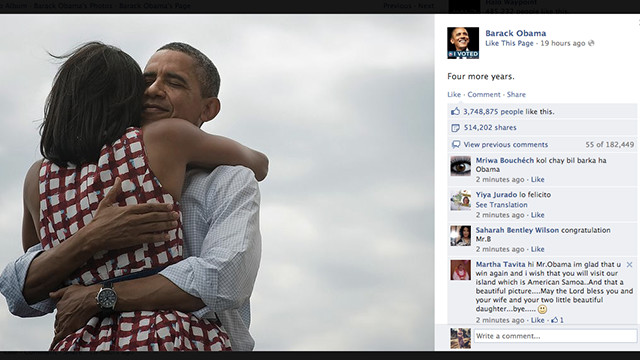
Barack Obama posted this image on his Facebook page Tuesday night.
(CNN) -- Facebook, where people love to discuss politics and complain about other people discussing politics, saw a huge surge in Election Day chatter on Tuesday.

In a stunning nod to the power of social media in this election, Obama's first public acknowledgment of victory was a post shared on Twitter and Facebook. It read "Four more years" and included a photo of Barack and Michelle Obama hugging.

That single post was the most retweeted in the history of Twitter (more than 700,000 times), and on Facebook it raked in an astounding 3.5 million likes and almost 500,000 people shared it on their own Timelines.

Over the course of the day, there were more than 71.7 million election related posts and comments on Facebook in the United States and 88.7 million around the world.

According to Facebook's internal Talk Meter, which measures how much buzz events get on the network, the election was the most talked about event in 2012. It was especially popular among 25- to 34-year-olds and in D.C., Mississippi and Virginia. It was also a huge topic internationally. Canada, the United Kingdom and Australia were the top countries posting about the election.

Obama was mentioned 10 million times on Facebook during Election Day. In just one hour, from 11 p.m. to 12 a.m., he was mentioned 4.1 million times on Facebook -- more than Romney's 4 million total for the entire day.

Not everyone appreciates having political posts fill their Facebook feed. Heightened emotions have let to angry fights in comment threads, interfamily drama and unfriendings. The negativity has even caused some to declare they are leaving the social network for a while.

Quitting Facebook isn't the only way to cut out the politics. You also can install tools that remove political posts automatically, such as the browser extensions Social Fixer or Noppl. Unpolitic.me will not only block the offending posts, it will replace them with the ultimate bipartisian animal, cats.

Top Election Day terms on Facebook:
1. Obama
2. Vote / Voted
3. Romney
4. Election
5. President
6. Country
7. Win / Wins
8. Line
9. Four More Years / 4 More Years
10. Ohio